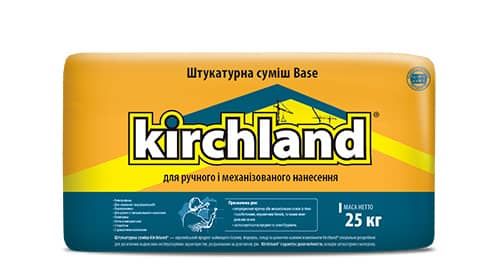
Base plaster mix
Base plaster mix for manual and machine application.
Technical data
| Composition | Cement-lime mix with mineral fillers |
| Service temperature | °C: -50…+70 |
| Compressive strength limit, MPa, not less than | 2.5 |
| Water absorption (over 48 h, %) | 1.6 |
| Vapor permeability, mg/(m·h·Pa), not less than | 0.1 |
| Thermal conductivity | 0.3 |
| Application temperature, °C | °C: +5…+30 |
| Frost resistance, not less than | 50 |
| Application thickness, mm | 25 |
| Mortar consumption | approximately 12.5-16 kg/m² per 10 mm |
| Water amount | 4.75-5.5 |
| Disposal | Dispose of product residue as construction waste, and packaging as household waste. |
| Packaging | Kirchland Base mix is packaged in 25 kg paper bags. |
| Storage | In the manufacturer's sealed original packaging, in dry rooms on wooden pallets, 12 months from the production date indicated on the packaging. |
Application
Follow the requirements of DBN V.2.6-22:2001 when carrying out all work.
For hand application, gradually add dry Kirchland Base mix into a container of water while mixing with a mixer fitted with a special paddle, or a forced-action mixer, at low speed. Mix for 3-5 minutes, working the mortar to a smooth mass with no lumps. The mixing water amount is approximately 4.75-5.5 L per 25 kg of dry mix.
Apply the prepared mortar with a mason's trowel or hawk, and within 5-7 minutes level it with a metal straightedge against the screed rails, then remove the rails. Fill any unfilled areas with Kirchland Base mortar using a trowel and level. After a 1.5-2 hour technological break, the surface is cross-raked, lightly dampened and floated with a plastering float.
For machine application, any plastering station can be used. Apply Kirchland Base plaster mix to the prepared substrate with the machine, and within 5-10 minutes level it with a metal straightedge against the screed rails, then remove the rails.
Fill any unfilled areas with Kirchland Base mortar using a trowel and level. After a 1.5-2 hour technological break, the surface is cross-raked, lightly dampened and floated with a plastering float. About 10 minutes after floating the plaster, smooth the partially dried surface with a foam float.
When forming a reinforced plaster layer, embed an alkali-resistant reinforcing fibreglass mesh with a density of at least 145 g/m². Lay the mesh into the plaster layer with a 10 cm overlap, and at corners and junctions between dissimilar surfaces - at least 25 cm.
For multi-coat application, and where tile cladding will follow, do not float the surface.
Keep the plastered surface damp for 48 hours after finishing work.
Before proceeding with further work, allow a curing period of 10 days per every 10 mm of plaster layer thickness. Painting and applying decorative coatings can be done no sooner than 28 days later.