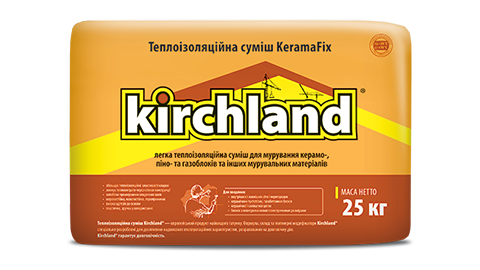
KeramaFix thermal-insulating masonry mix
Kirchland "KeramaFix" thermal-insulating mix is a ready-mixed dry masonry mortar for laying exterior and interior walls and partitions from various ceramic thermal-insulating units (hollow ceramic blocks, hollow ceramic brick, etc.).
Technical data
| Composition | Cement mix with mineral fillers and organic modifiers. |
| Mix ratio | 3.75-4.25 L of water per 25 kg of dry mix. |
| Pot life of the mixed mortar | 60-120 minutes. |
| Application temperature, °C | +5 to +30. |
| Service temperature | -50°C to +70°C. |
| Compressive strength after 28 days | at least 5.0 MPa. |
| Adhesion (bond strength), MPa | at least 0.2 MPa. |
| Frost resistance, not less than | at least 50 cycles. |
| Thermal conductivity | not more than 0.17 W/(m·K). |
| Joint thickness | 5-20 mm; for ceramic blocks, at least 12 mm. |
| Storage | In the manufacturer's sealed packaging, in dry rooms, 12 months from the production date indicated on the packaging. |
| Packaging | Bags of 25 kg. |
| Mortar consumption | From 20 kg per 1 m² of a 380 mm thick wall made of 240×240×380 mm hollow ceramic blocks with a 12 mm joint thickness. Mix consumption depends on the applicator's skill. |
Application
Mix the dry Kirchland "KeramaFix" compound with clean water (water temperature +15°C to +20°C) at a ratio of 3.75-4.25 L of water per 25 kg of dry mix and stir until a smooth, lump-free mass is obtained using a mixer or a low-speed drill with a paddle.
After preparation, let the mortar rest for 5 minutes, then stir again.
The mortar can be used for 60-120 minutes.
Work must be carried out at a substrate temperature between +5°C and +30°C.
The substrate on which masonry work is carried out must be load-bearing, level, intact, and fully cured with mechanical and setting deformation complete (at least 28 days).
The surface of the substrate and building units to which the mortar will be applied must be level, dry, and free of substances that reduce adhesion (oil stains, old plaster, etc.).
Kirchland "KeramaFix" mortar should be applied over the whole masonry surface with a mason's trowel, in an even layer 5-20 mm thick; the optimal horizontal joint thickness for ceramic blocks averages 12 mm. When laying the next horizontal course, lightly moisten the top surface of the lower course of blocks with water. When laying ceramic blocks with a tongue-and-groove profile on the side faces, mortar is not applied to these faces - the blocks are joined dry. For this block type, mortar is applied to the side faces only when cutting blocks or joining to other vertical surfaces. For blocks without a tongue-and-groove profile on the side faces, mortar is applied to these faces as well, to form vertical joints.
All recommendations above are valid at a temperature of +20°C and relative humidity of 60%. Under other conditions, drying time may change.
Kirchland "KeramaFix" mortar contains cement and reacts alkaline on contact with water, so eyes and skin must be protected while working. If the mix gets into the eyes, rinse immediately with water and seek medical help. Do not mix with other fillers, aggregates or binding materials.