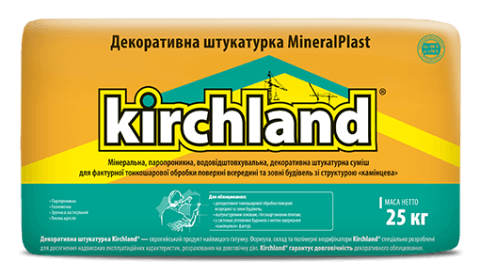
MineralPlast decorative plaster
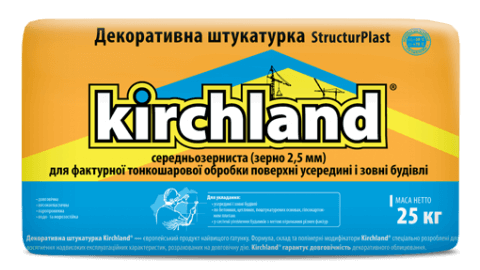
Kirchland "MineralPlast" is designed for decorative thin-layer surface finishing indoors and outdoors, on concrete and plastered substrates and gypsum board, as well as in facade insulation systems, to achieve "pebble-effect" textures.
Technical data
| Composition | White cement with mineral fillers and polymer modifiers. |
| Mortar consumption | 1.5 mm grain - 2.0 kg/m²; 2 mm grain - 2.8 kg/m². |
| Mix ratio | 5.0-5.25 L of water per 25 kg. |
| Pot life of the mixed mortar | at least 60 minutes. |
| Substrate temperature | +5°C to +30°C. |
| Adhesion (bond strength), MPa | 0.5 MPa. |
| Vapor permeability, mg/(m·h·Pa), not less than | 0.05 |
| Color | White. |
| Storage | In the manufacturer's sealed original packaging, in dry rooms on wooden pallets, 12 months from the production date indicated on the packaging. |
Application
Mix the dry compound with clean water (temperature +18...+20°C) at a ratio of 0.2-0.21 L of water per 1 kg of dry mix and stir until a smooth, lump-free mass is obtained using a drill and mixing paddle.
Let the mortar rest for 5-10 minutes, then stir again.
The mortar can be used for at least 60 minutes.
Apply the plaster to the substrate using a stainless-steel trowel or float. The plaster is applied to the substrate in a 3-4 mm layer. The coating thickness is then shaped to match the grain size, holding the tool at a 45° angle to the surface being worked, removing excess mortar. Once the mortar stops sticking to the tool, at the point of initial set (5 to 20 minutes depending on the substrate and application conditions), start forming the texture with a plastic float.
When forming the texture, hold the tool parallel to the surface being worked. After the texture is formed, the surface can be painted with silicone-based paints after 72 hours, or with acrylic- and silicate-dispersion-based paints after 14 days. Material consumption depends on the applicator's skill. Exact consumption is determined by applying a test coat on the specific site.