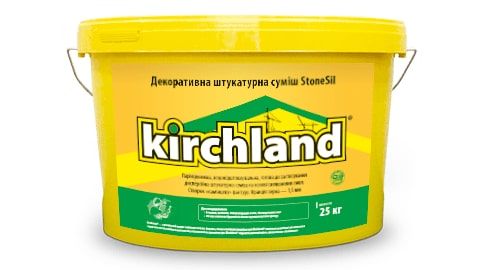
StoneSil decorative plaster mix
Silicone "pebble-effect" decorative plaster. For finishing concrete, brick and plastered substrates, gypsum board and facade insulation systems, to achieve various textures.
Technical data
| Composition | Silicone resin-based dispersion, pigments, mineral fillers, additives, water. |
| Gloss level | Matte. |
| Density, g/m³ | 1600. |
| Water absorption coefficient | 0.2. |
| Adhesion (bond strength), MPa | 0.3 MPa. |
| Vapor permeability, mg/(m·h·Pa), not less than | 0.03. |
| Consumption (1.5 mm notch), kg/m² | 2.5 to 2.8. |
| Consumption (2 mm notch), kg/m² | 3.2 to 3.5. |
| Frost resistance, not less than | 50 cycles. |
| Compressive strength limit, MPa, not less than | 5. |
| Color | White. Machine-tintable using the NCS, Symphony, RAL systems. |
| Disposal | Dispose of hardened material residue as household waste. |
| Storage | Store in tightly closed packaging, in a cool place protected from sunlight, at a temperature of +5°C to +35°C. |
| Warranty storage period | In the original sealed packaging - 18 months from the production date. |
Application
Thoroughly mix Kirchland StoneSil decorative plaster with a low-speed mixer. If necessary, dilute with water to adjust consistency: no more than 1% for hand application, no more than 2% for machine application.
Kirchland StoneSil decorative plaster mortar is applied to the surface with a stainless-steel trowel or suitable equipment. The applied layer thickness should match the plaster's grain size. Excess mortar must be removed immediately, holding the trowel at an angle. At the point of initial set, start forming the texture with a plastic float, working the surface with even movements. Enough workers per work area are needed to avoid visible seams in the plaster. The material is applied quickly, using a "wet-on-wet" method. Since the plaster mix contains natural fillers, slight colour variation is possible. Therefore, adjoining surfaces should use material from a single batch, or material from different batches should be pre-mixed. Use only clean tools.
Exact consumption is determined by applying a test coat on the specific site.
During mixing, application and drying of the material, ambient and substrate temperature must not be lower than +5°C or higher than +35°C.
Do not carry out work in direct sunlight, strong wind or precipitation.
At +20°C and 65% air humidity, the plaster becomes surface-dry after 24 hours. At lower temperature and higher humidity, drying time increases accordingly. While drying, the material must be protected from rain by covering the scaffolding with a tarp or special netting.
Wash tools with water immediately after use.
If it gets into the eyes, rinse immediately and thoroughly with water and see a doctor.
If it gets on skin, wash off immediately with soap and water. Do not allow it to enter drains, water bodies or soil. If swallowed, seek medical help immediately, as it may harm intestinal microflora.